

Empowering Women Through Sustainable Livelihoods
How GLLSP-II is transforming fishing communities by equipping women with income-generating assets
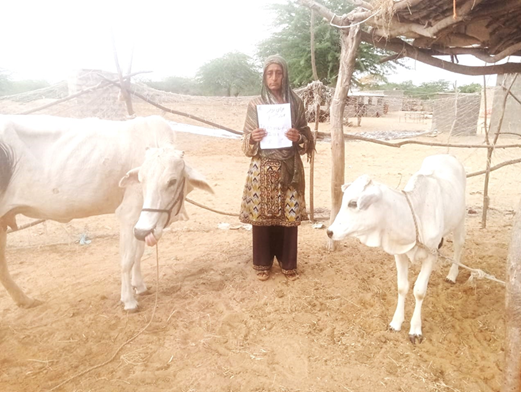
In Taj Muhammad Bandicha Goth, Uthal, Bachai never imagined that a single dairy cow could change her family’s fate. Yet today, as she pours fresh milk into steel canisters, she sees financial stability where there was once uncertainty.
“This animal feeds us when the sea doesn’t,” she says, watching her children chase a newborn calf across their yard.
Her journey reflects that of hundreds of women across coastal Balochistan, rewriting their destinies through Gwadar Lasbela Livelihoods Support Project (GLLSP-II), implemented by NRSP with funding from IFAD. Through the BISP Poverty Scorecard, the program identifies the most vulnerable households, providing assets and training that help them break free from poverty.
The Challenge: Tides of Hardship
For families like Bachai’s, relying solely on fishing meant constant uncertainty.
Her husband, Muhammad Raheem, earned Rs. 19,000 per month, but the income was unpredictable. The family often skipped meals, especially during monsoon bans, when fishing was impossible. Medical emergencies led to crippling debt, leaving them with no financial security.
“Private milk vendors paid Rs. 40 per liter—barely enough to cover feed costs,” she recalls, highlighting the exploitative systems that GLLSP-II aims to reform.
The Solution: A Holistic Dairy Model
To create sustainable alternatives, GLLSP-II introduced an integrated dairy farming approach for coastal communities.
Asset Provision & Training
Women received cows that were adapted to coastal environments (LIP NRSP-B-L-KW-2111).
They underwent hands-on coaching in animal healthcare, milk hygiene, and business skills.
The project linked them with mobile veterinary clinics for vaccinations and breed improvements.
The Transformation
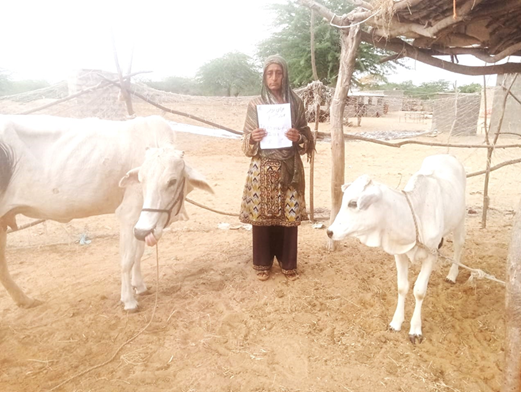
Bachai’s household has seen a dramatic shift since she received her cow.
- Income: Household earnings have doubled
- Nutrition: Her children now consume 2 liters of milk daily
- Assets: A first calf was born within three months, with plans for future herd expansion
Voices from the Ground
“Now I contribute equally to household decisions. My husband says the cow is our second boat,” says Bachai with pride.
Her neighbor Fatima, inspired by her success, shares: “I joined the poultry program after seeing her progress. My turn to rise.”
BOXES:
- “This animal feeds us when the sea doesn’t,” she says, watching her children chase a newborn calf across their yard.
- For families like Bachai’s, relying solely on fishing meant constant uncertainty.
- “Private milk vendors paid Rs. 40 per liter—barely enough to cover feed costs,” she recalls, highlighting the exploitative systems that GLLSP-II aims to reform.